
Can AI Predict the 2026 World Cup Winner?

Updated: Jul 12
Tournament update: All four AI models correctly predicted Spain, France, England and Argentina as the semi-finalists. They also unanimously identified Norway as the dark horse and Brazil as the likely biggest disappointment. Norway reached the quarter-finals and eliminated Brazil before losing to England.
The 2026 FIFA World Cup starts on 11 June, and for the first time the tournament features 48 teams, 12 groups and a new Round of 32 knockout stage.
That makes it bigger, harder to forecast, and probably even more chaotic than usual.
So, with squads confirmed and the tournament just days away, I tried a simple experiment:
Can AI predict who will win the 2026 World Cup?

To test this, I gave four AI models the same structured context pack covering final squads, injuries, betting markets, Opta probabilities, route difficulty, dark horses and key tournament risks.
The models used were:
ChatGPT 5.5 Thinking
Gemini 3.1 Thinking
Grok (Expert)
Claude Sonnet 4.6 (Medium Thinking)
Each model received the same prompt and was asked to predict:
the winner
the runner-up
the other semi-finalists
a surprise package
the biggest disappointment
a top scorer candidate
the best dark horse
its own confidence level
the probability of its predicted winner actually winning
the assumptions that could make the prediction fail
The goal was not to treat AI like a crystal ball. AI cannot know the future, but it can compare evidence, expose assumptions, and help us think more clearly about uncertainty.
The real goal was to see how different AI models reason when given the same information.
The Baseline: Spain Start as Favourites
Before asking the models, I gave each one the same shared evidence base, built from a Perplexity Deep Research report with citations to squad announcements, bookmaker markets, Opta-style forecasts and route analysis.
Spain entered the tournament as the strongest statistical and market favourite. Opta’s 25,000 simulations put Spain at around 16% to win the tournament, ahead of France, England and Argentina.
That is important wording.
Spain are not “likely” to win in the everyday sense. Even as favourites, they are still far more likely not to win than to win.
That distinction matters.
A 16–18% chance means Spain may be the most likely single winner, but the combined field is still much stronger. This is where predictions often go wrong: people turn a probability ranking into a confident statement.
AI can do the same thing if we are not careful.
What the AI Models Predicted
Here is the broad comparison.
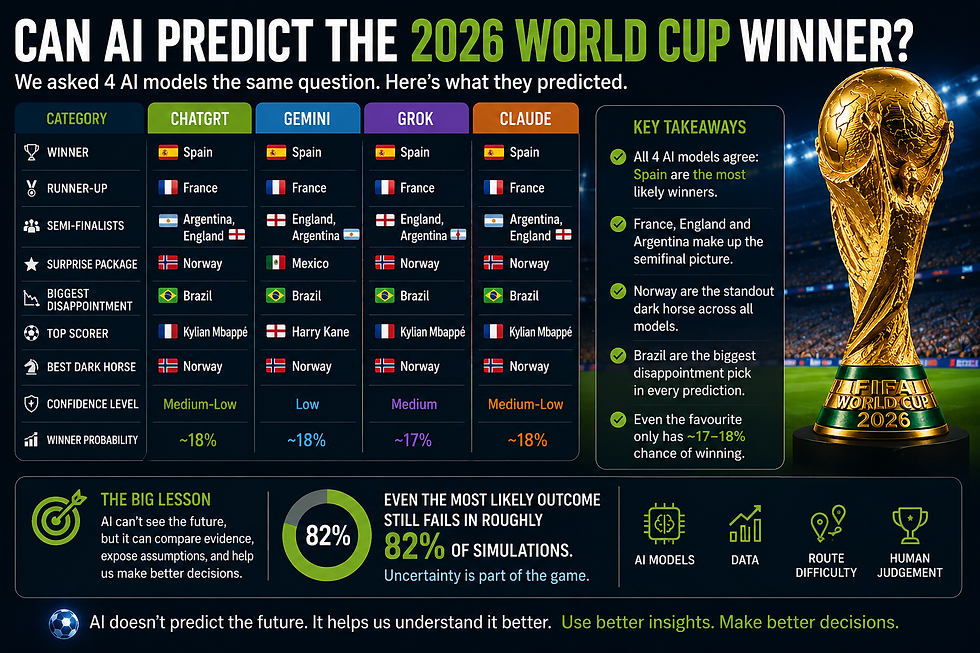
Model | Winner | Runner-up | Other semi-finalists | Surprise package | Biggest disappointment | Top scorer | Dark horse | Confidence |
ChatGPT | Spain | France | Argentina, England | Norway | Brazil | Kylian Mbappé | Norway | Medium-low |
Gemini | Spain | France | England, Argentina | Mexico | Brazil | Harry Kane | Norway | Low |
Grok | Spain | France | England, Argentina | Norway | Brazil | Kylian Mbappé | Norway | Medium |
Claude | Spain | France | Argentina, England | Norway | Brazil | Kylian Mbappé | Norway | Medium-low |
The headline result is obvious:
All four models picked Spain to win the 2026 World Cup.
All four also picked France as runner-up.
All four had England and Argentina as the other semi-finalists.
All four picked Brazil as the biggest disappointment.
And all four identified Norway as either the main surprise package, the best dark horse, or both.
That level of agreement is interesting — but it should not be mistaken for certainty.
Why Did Every Model Pick Spain?
The models broadly agreed on Spain for four reasons.
First, Spain have the strongest statistical case. They are the reigning European champions and sit at the top of the pre-tournament prediction models.
Second, their midfield looks extremely strong. Rodri, Pedri, Gavi, Zubimendi and Fabián Ruiz give Spain control, depth and flexibility. In tournament football, midfield control still matters enormously.
Third, Lamine Yamal gives them a difference-maker in attack. Spain are not just a possession side. They have directness, width and creativity.
Fourth, their route looks better than some of their rivals. England may have a manageable group, but their possible knockout path could become very difficult. France are extremely strong, but Group I includes Norway and Senegal, making it the hardest group by the supplied context.
Spain look like the best blend of squad quality, form, structure and route.
But again, that does not make them a safe bet.
The models generally placed Spain’s chance of winning at around 17–18%. That means the shared AI view is closer to:
“Spain are the most likely winner.”
Not:
“Spain will win.”
That difference is the whole point of the experiment.
Where the Models Agreed
The most striking agreement was the top four.
Spain, France, England and Argentina appeared across all four model predictions as the likely semi-final group.
That makes sense. They are also the strongest cluster in the market and statistical forecasts.
France have the attacking quality and tournament experience. Kylian Mbappé, Ousmane Dembélé and a deep defensive group make them dangerous in any knockout match.
England have Harry Kane, Jude Bellingham, Declan Rice and a strong qualifying record under Thomas Tuchel. But the models were cautious because England’s possible route looks punishing.
Argentina have the easiest elite group and retain much of the experience from their 2022 World Cup win. But Lionel Messi’s age and minor hamstring issue introduce uncertainty, especially across an expanded tournament.
So the models broadly did what a careful human analyst might do: they clustered around the strongest teams, then adjusted for route, injuries and squad depth.
That is useful.
But it is not magic.
Where the Models Disagreed
The biggest difference came in the “surprise package” and “top scorer” picks.
Most models picked Norway as the surprise package. That is understandable. Erling Haaland and Martin Ødegaard give Norway a high-ceiling attacking combination, and Norway’s 3.5% Opta win probability makes them the most credible dark horse in the supplied data.

Gemini, however, picked Mexico as the surprise package.
That is a useful disagreement. Mexico are hosts, open the tournament at the Azteca, and could benefit from crowd advantage and a favourable Group A. They are unlikely to win the tournament, but they could exceed expectations.
For top scorer, three models picked Kylian Mbappé. Gemini picked Harry Kane.
Again, both are defensible.
Mbappé has World Cup pedigree and France are expected to go deep. Kane has elite club form and England’s group could give him chances to score early before the knockout rounds tighten.
This is where comparing models becomes useful. The value is not just in the final answer. It is in seeing which evidence each model appears to weight more heavily.
One model may prioritise tournament depth. Another may prioritise group-stage scoring opportunity. Another may lean toward statistical favourites. Another may give more weight to home advantage.
The disagreement is not a bug. It is part of the insight.
The Brazil Warning
All four models picked Brazil as the biggest disappointment.
That does not mean Brazil are a poor team. Far from it.
Brazil still have elite attacking talent, huge tournament history and a manager in Carlo Ancelotti with one of the strongest CVs in football.
But the models saw a gap between Brazil’s reputation and the current risk profile.
The concerns are clear:
Brazil finished fifth in CONMEBOL qualifying
Neymar has a Grade 2 calf injury
The Morocco opener looks tricky
Ancelotti is managing an international squad at a major tournament for the first time
Market expectations may still carry a “Brazil are always contenders” premium
This is a good example of AI picking up a classic forecasting issue: reputation can lag reality. That happens in business too. A product, brand, department or process may still be treated as strong because it used to be strong. But current data may tell a more complicated story.
Good forecasting has to separate the badge from the evidence.
What This Tells Us About AI Forecasting
The most important lesson is not that “AI thinks Spain will win.” The lesson is that AI predictions are only useful when the assumptions are visible.
A weak AI answer would be:
“Spain will win the World Cup.”
A better AI answer is:
“Spain are the most likely winner based on current evidence, but their actual chance is only around 17–18%, and the prediction depends on player fitness, route stability, and the expanded tournament format not producing major early chaos.”
That second answer is far more useful.
It shows uncertainty. It explains trade-offs. It reveals assumptions. It gives the reader something to challenge.
This is where AI becomes valuable in business. Not as an oracle, but as a structured reasoning tool.
Why the Models Might Still Be Wrong
The 2026 World Cup is especially hard to predict because the format has changed.
There is now an extra knockout round. More teams qualify from groups. Travel demands are higher. Weather and recovery may matter more. A single penalty shootout, red card, VAR decision or injury can reshape the entire bracket.
That means any confident prediction should be treated carefully.
The models may also over-weight the same shared signals. If all four models see Spain as the statistical favourite, they may converge around Spain partly because the data nudges them there.
Consensus is useful, but it is not proof.
Four models agreeing does not make the future certain. It may simply mean they are all reading the same evidence in a similar way.
That is why human review still matters. Keep humans in the loop.
The Business Lesson: Use AI to Compare Reasoning, Not Just Answers
This World Cup experiment has a wider lesson for small businesses, teams and decision-makers.
If you ask one AI model a question, you get one answer.
If you ask several models the same question, using the same context, you start to see patterns:
where they agree
where they diverge
which assumptions they rely on
which risks they ignore
whether they show uncertainty
whether they explain their reasoning clearly
That is much more useful than simply asking, “What should I do?”
For business decisions, AI can help compare options, forecast scenarios and identify risks. But it should not be used as a final authority without human judgement.
The smart approach is:
Give AI good context.
Ask for structured reasoning.
Compare outputs.
Look for assumptions.
Challenge the answer.
Make the final decision yourself.
That applies whether you are predicting a football tournament, planning stock levels, reviewing customer data, choosing marketing priorities or deciding where AI could support your business.
So, Can AI Predict the World Cup Winner?
Sort of.
AI can make a structured, evidence-led prediction. It can compare squads, probabilities, routes, injuries and market signals. It can explain why Spain look like the best pre-tournament pick.
But it cannot remove uncertainty.
It cannot know when a teenager will become a global star overnight.
It cannot know when a red card, penalty shootout or tactical mismatch will break the bracket.
And it cannot know when a goalkeeper will have the game of his life. AI didn't foresee Cape Verde reaching the knockout stages. Nor did it predict Vozinha, a 40-year-old veteran keeper, pulling off 15 saves to help his team earn a point vs World Cup favourites, Spain.
So the fairest answer is this:
AI can help us think more clearly about who might win the World Cup.
It cannot tell us who will win.
For this experiment, the models agreed on Spain. But even then, the estimated probability was only around 17–18%.
That means the strongest prediction is also a reminder to stay humble.
Football is not a spreadsheet. And AI, at its best, should help us understand uncertainty — not pretend it has disappeared. Note: The shared evidence base used for this experiment was generated using Perplexity Deep Research and checked against cited sources including Opta-style tournament probabilities, squad announcements, bookmaker markets and route analysis. The AI model answers were then compared against the same baseline rather than each model researching separately.
In Closing
This experiment was about football, but the lesson applies far beyond sport.
AI predictions are most useful when they help you compare options, expose assumptions, and make uncertainty easier to discuss. Whether you are planning a campaign, reviewing business data, choosing tools, or exploring automation, the value is not in asking AI for “the answer” — it is in using AI to support better human judgement.
If your organisation is starting to explore AI and needs a clearer plan, Mercia AI’s AI Strategy Builder can help turn broad ideas into a practical, responsible roadmap.