How AI Will Shape the 2026 World Cup
- Chris Howell
- May 16
- 6 min read

Updated: Jun 13

The 2026 FIFA World Cup will not be run by artificial intelligence — but AI will quietly sit underneath almost every part of the tournament.
From AI-assisted offside calls and smart footballs to crowd-flow monitoring, multilingual fan tools, and automated media production, the competition across the USA, Canada and Mexico is shaping up to be the most technology-heavy World Cup in history.
The interesting part is not that AI is “taking over football.” It isn’t. The real story is that AI has become part of the operational backbone of elite sport — supporting decisions, scaling logistics, surfacing patterns, and helping people process more information, faster.
And that lesson extends far beyond football.
AI-Enhanced VAR Is Going Even Further
The most visible use of AI at the 2026 World Cup will likely be officiating.
FIFA has upgraded its semi-automated offside technology first seen at Qatar 2022. This time, every player at the tournament will be digitally scanned to create AI-enabled 3D avatars designed to improve accuracy during fast or obstructed movements. Assistant referees will receive real-time audio feedback through earpieces, while broadcasters will show more realistic 3D replay visualisations to fans watching at home.
The official Adidas Trionda match ball also contains a connected-ball chip transmitting movement and positional data 500 times per second into the officiating system. That data helps determine the exact moment a pass is played during offside decisions.
In one of the tournament’s more controversial changes, FIFA has also confirmed that VAR will now extend to corner kicks using AI-powered ball tracking. Critics argue this risks increasing stoppages and further damaging trust in the system if execution is inconsistent.
The important point here is that AI is still supporting the referee — not replacing them. Human officials remain responsible for the final decision.
That distinction matters outside football too. Businesses adopting AI-assisted tools for pricing, forecasting, customer support, or operations should treat AI as decision support, not autonomous authority.
Football AI Pro Could Change Competitive Balance
One of the biggest stories of the tournament may barely be visible to fans.
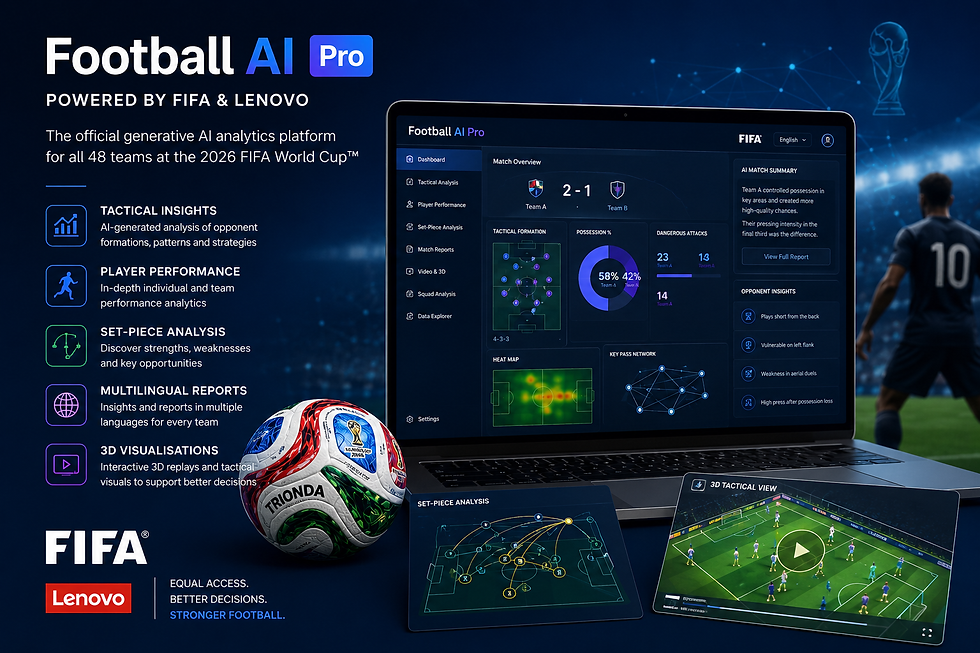
FIFA and Lenovo have launched Football AI Pro, a generative AI analytics platform available to all 48 competing national teams. The system analyses huge volumes of FIFA-owned data and generates tactical insights using text, video, graphs, and 3D visualisations.
Historically, richer footballing nations could afford large analytics departments and advanced performance systems. Smaller nations often could not.
Football AI Pro potentially narrows that gap.
Every team now gets access to opposition analysis, tactical comparisons, set-piece pattern analysis, player performance insights, and multilingual AI-assisted reporting.
That mirrors what is happening in business right now. AI tools that once required enterprise budgets are increasingly available to smaller organisations and solo operators.
The playing field is not perfectly level — but it is becoming flatter.
AI Will Help Run the Tournament Behind the Scenes
The 2026 World Cup is an operational monster.
There are 48 teams, 104 matches, 16 host cities, three countries, and four time zones.
FIFA’s technology partners are using AI heavily to manage that complexity. Lenovo has deployed an AI-powered Intelligent Command Centre capable of monitoring live operations across the tournament footprint. Every venue has also been digitally scanned into a “digital twin” feeding live operational data into the system.
Smart wayfinding systems will help fans navigate venues and transport hubs in real time, while AI-assisted crowd-flow systems and surveillance analytics will help manage congestion and security operations.
This is one of the clearest examples of AI’s real-world value: not replacing people, but helping humans manage complexity at scale.
For small businesses, the lesson is familiar: forecasting demand, monitoring bottlenecks, spotting operational issues early, and reacting faster to changing conditions.
Those capabilities are no longer exclusive to large enterprises.
The World Cup Could Become an AI Content Explosion
AI will also heavily influence how fans experience the tournament online.
Broadcasters and media companies are increasingly using AI-assisted workflows for automated clipping, metadata tagging, social media highlights, subtitle generation, and content recommendations.
FIFA has even designated TikTok as its first-ever “Preferred Platform” for video content during the tournament.
That means the World Cup is likely to generate an unprecedented flood of AI-assisted short-form content: highlight clips, reaction videos, AI-generated previews, translated social posts, and personalised feeds.
Importantly, human commentators are not being replaced. Fox Sports has already confirmed full human commentary teams for the tournament. AI is augmenting production workflows rather than replacing presenters outright.
Again, there is a broader business lesson here.
Small businesses now have access to tools that can auto-caption videos, generate clips, create social content, and speed up production workflows.
But faster content creation still requires human review, judgement, and quality control.
Dynamic Pricing Shows the Risks of AI Without Trust
One of the most controversial uses of AI-related systems around the 2026 World Cup has not involved VAR or refereeing at all.
It has involved ticket prices.
FIFA’s variable pricing model has pushed some premium final tickets close to $11,000, triggering significant backlash from supporters and fan organisations. While FIFA argues the system reflects enormous demand for a tournament expected to attract billions of viewers, critics say the pricing model feels increasingly detached from ordinary fans.
The wider lesson is important.
AI-assisted pricing systems can optimise revenue extremely effectively, but optimisation alone is not the same thing as trust.
Businesses adopting algorithmic pricing tools need to think beyond short-term yield. Customers care about fairness, transparency, and whether pricing still feels human. A system that maximises every possible pound today can quietly damage long-term relationships tomorrow.
In many ways, the World Cup ticketing debate is becoming a live case study in the trade-offs between AI-driven optimisation and customer trust.
The Risks Are Growing Too
The report also highlights something important: the same AI risks affecting the World Cup are increasingly affecting normal businesses too.
Security researchers identified more than 4,300 fake FIFA-related websites before the tournament even began. Researchers also discovered phishing sites designed to mimic the official FIFA site using AI-generated content and cloned branding.
Deepfakes are another growing concern. The Center for Internet Security has classified AI-generated misinformation and synthetic media as a major operational risk for large-scale events like the World Cup.
Potential threats include fake emergency alerts, fabricated player or coach statements, impersonation scams, and AI-generated misinformation spreading rapidly during matches.
The lesson is straightforward: AI makes scams, fraud, and misinformation faster, cheaper, and more convincing.
That is no longer a future problem.

AI Supports Decisions — It Doesn’t Replace Them
One of the most interesting themes running through the 2026 World Cup is the tension between automation and trust.
AI can surface patterns, improve speed, process huge volumes of information, and scale operations.
But it still struggles with transparency, edge cases, accountability, and human context.
That is true whether you are reviewing an offside decision, forecasting hotel demand, setting ticket prices, or running a small business.
The World Cup may showcase some impressive technology this summer, but the biggest lesson is probably a simple one:
AI works best when humans remain accountable for the final call.
Beyond football, the 2026 World Cup is becoming a live demonstration of how AI is entering mainstream operations — not as magic, but as infrastructure.
And increasingly, the same tools and trade-offs facing FIFA, broadcasters, and national teams are beginning to appear inside ordinary businesses too.
The same principle applies to business AI. Whether you are exploring automation, analytics, customer tools or content workflows, the goal is not to hand every decision to AI. It is to build a clear, practical strategy where AI supports better human judgement.
If you are thinking about how AI could fit into your organisation, the AI Strategy Builder is designed to help turn broad ideas into a focused, responsible plan.