
How AI and Data Are Changing MotoGP

Behind every MotoGP rider is a team of engineers analysing enormous amounts of information. But how much of that technology is actually artificial intelligence?
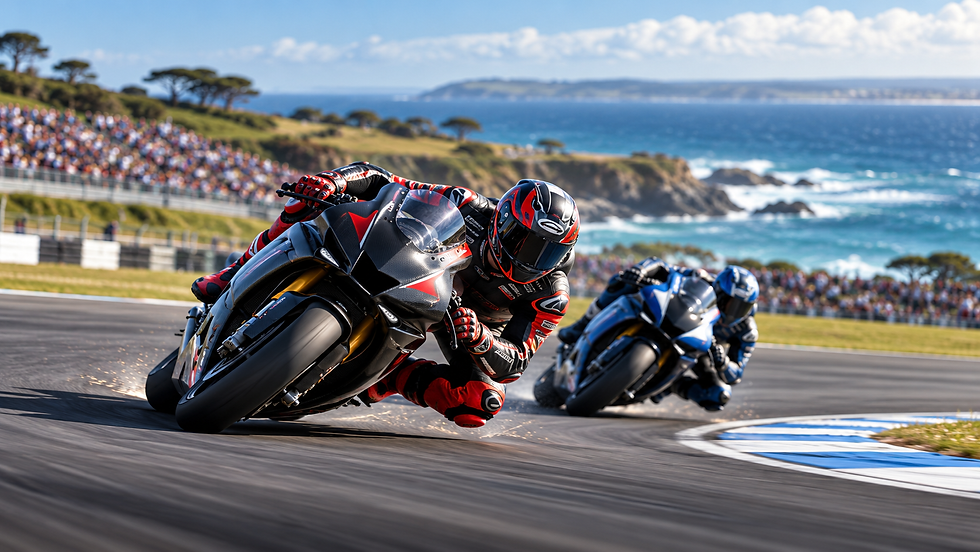
Watching a MotoGP rider lean into a corner at extraordinary speed, it's easy to focus entirely on the person controlling the motorcycle. Every movement matters, from applying the brakes to opening the throttle and finding enough grip to accelerate out of the corner. At speeds exceeding 300 km/h, even the smallest adjustment can make a significant difference.
Yet behind that rider is another competition taking place, one involving data, engineering and increasingly, artificial intelligence. Modern MotoGP motorcycles are packed with sensors, while manufacturers such as Ducati and Aprilia are exploring how AI can help engineers understand performance and make better decisions.
But the technology isn't riding the motorcycle. Understanding the difference between AI, conventional electronics and human expertise reveals something interesting about how modern motorsport is evolving.
What Data Does a MotoGP Motorcycle Collect?
A modern MotoGP motorcycle is effectively a sophisticated data-collection platform travelling around a racetrack. Throughout a session, sensors record detailed information about the motorcycle's performance, capturing measurements that engineers can examine when the rider returns to the garage.
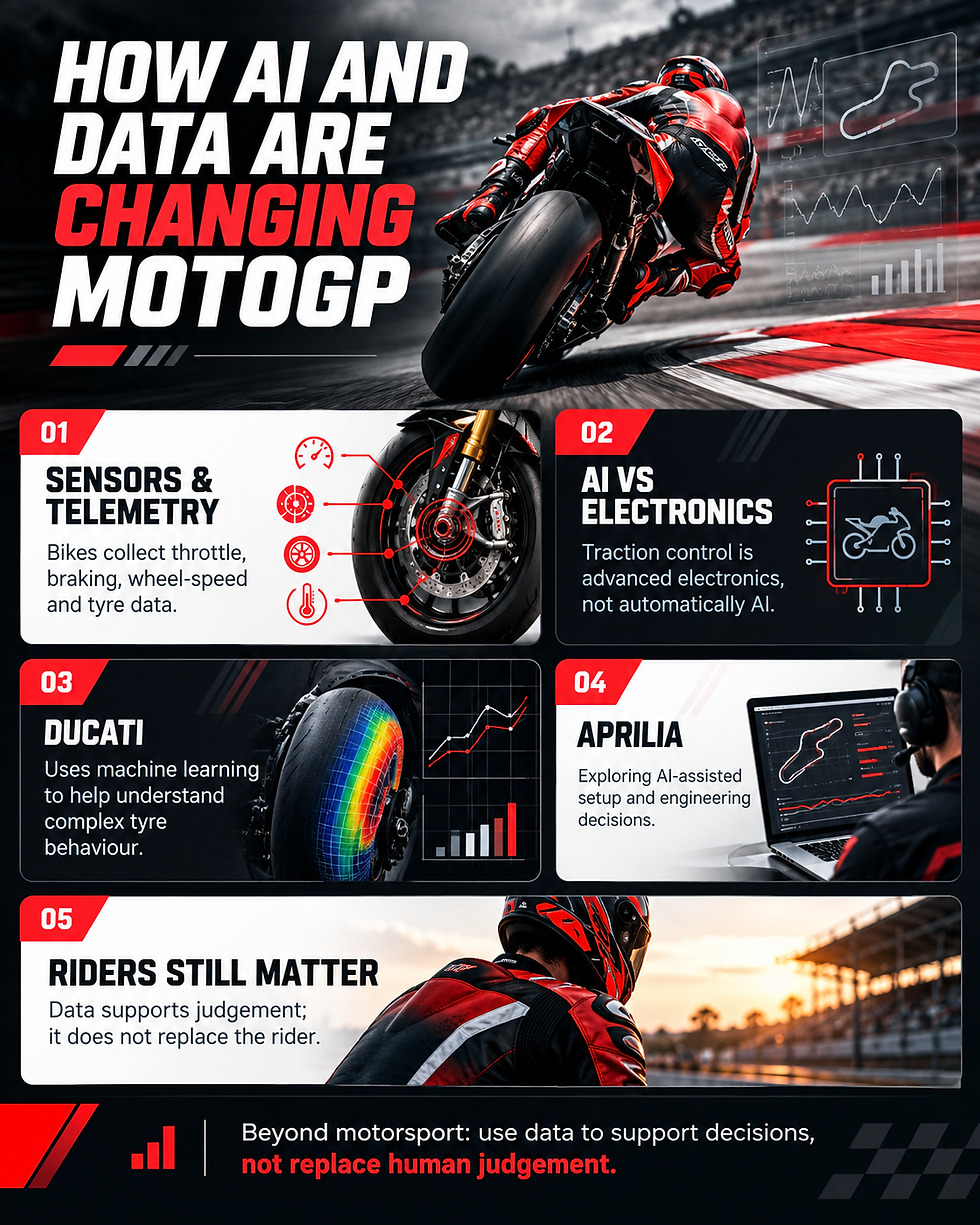
These measurements include throttle position, brake pressure, engine performance, wheel speeds, tyre temperatures and suspension movement. Sensors also provide information that can be used to calculate the motorcycle's lean angle, helping engineers understand how it behaves through different corners.
However, not everything can be measured directly. Tyre grip, for example, isn't something a single sensor can simply report. Engineers must estimate available grip by examining several measurements, including wheelspin, temperature, pressure and acceleration, alongside information supplied by the rider.
The real value comes from bringing these measurements together. Engineers can compare successive laps, identify differences in braking and acceleration, and investigate why a rider might be losing time in a particular section of the circuit. What looks like an almost imperceptible difference when watching a race can become much clearer when the underlying information is analysed.
Why MotoGP Doesn't Have an F1-Style Pit Wall
One of the more surprising differences between MotoGP and Formula 1 concerns how engineering information reaches the teams.
In Formula 1, engineers receive extensive telemetry while their cars are circulating. This allows them to monitor performance and identify potential problems from the pit wall as they happen. MotoGP operates differently because its regulations restrict communication and data transmission between a moving motorcycle and its team.
Instead, much of the motorcycle's engineering information is recorded onboard and downloaded when the rider returns to the garage. Engineers then examine the measurements and discuss their findings with the rider before deciding whether adjustments might improve performance during the next session.
This makes rider feedback particularly valuable. If a rider reports that the rear tyre feels unstable when accelerating, engineers can compare that observation with information about wheel speed, throttle application and suspension behaviour. The rider describes what they experienced, while the data helps explain what might have caused it.
Television viewers may still see live graphics displaying speed, lean angle or other measurements. These come through separately controlled broadcast and timing systems, however, and shouldn't be confused with unrestricted live engineering telemetry being transmitted to individual teams.
Is MotoGP's Electronic Technology Actually AI?
MotoGP motorcycles already use highly sophisticated electronic systems designed to help riders manage the extraordinary performance available from their machines. These include traction control, engine-braking management and systems that help limit unwanted wheelies during acceleration.
Traction control provides a useful example. By processing measurements from the motorcycle's sensors, the system can identify excessive rear-wheel spin and adjust engine power according to its programmed control strategies. These calculations happen extremely quickly and can respond to changing conditions while the rider is on track.
It might sound like artificial intelligence, but sophisticated electronic control isn't necessarily AI. Traditional control systems operate using mathematical calculations, predefined strategies and carefully configured parameters. They can be remarkably advanced without learning new patterns from experience.
Machine learning introduces a different approach. Rather than relying entirely on relationships specified in advance by engineers, a machine-learning model can be trained on previous data to identify patterns that may be difficult to represent using conventional mathematical methods.
This distinction is particularly important when discussing motorsport technology. Sensors, predictive models, simulation software and electronic rider aids all contribute to performance, but they shouldn't automatically be described as artificial intelligence simply because computers are involved.
Ducati: Using Machine Learning to Understand Tyres
One of the clearest publicly documented examples of machine learning in MotoGP comes from Italian motorcycle manufacturer Ducati.
Through its technical partnership with Lenovo, Ducati Corse has used machine learning, high-performance computing and advanced simulation to support its engineering work. These technologies help specialists process large quantities of information and investigate possible improvements without having to physically test every configuration.
Tyres are a particularly challenging area. Their behaviour changes constantly according to temperature, pressure, loading, acceleration and the angle at which the motorcycle is leaning. Unlike a car tyre, a motorcycle tyre must operate across a changing contact area as the rider leans through corners, making its performance especially difficult to model accurately.
In Lenovo's published account, Ducati Corse technical director Davide Barana described how machine learning can help represent complicated tyre behaviour that conventional modelling struggles to capture. By identifying relationships in previous information, these systems can support engineers when evaluating how different conditions and configurations might affect performance.
However, it's important not to exaggerate what has been publicly established. Ducati and its technology partners have discussed the benefits of machine learning and advanced engineering tools, but the precise models, their operational deployment and their impact on lap times are not fully disclosed.
The significance isn't that AI has somehow replaced Ducati's engineers. Rather, it provides another way to investigate complicated engineering problems and potentially reach useful conclusions more efficiently.
Aprilia: Exploring AI-Assisted Setup Decisions
Ducati isn't the only MotoGP manufacturer investigating the possibilities of artificial intelligence. Aprilia Racing has also been developing advanced engineering capabilities through its partnership with RINA, with AI identified as an important part of the programme.
The partnership covers areas including performance analysis, engineering simulation and the exploration of AI-supported motorcycle setup decisions. One objective is to improve how engineers evaluate different configurations and respond to the varying demands of individual circuits.
Consider what happens when a team arrives at a racetrack. Engineers must balance suspension settings, electronic controls, tyre behaviour and the rider's preferences while accounting for differences in temperature, track conditions and circuit characteristics. These factors interact, meaning that changing one setting can influence several others.
AI-supported analysis could help engineers compare potential configurations and identify promising combinations more efficiently. Instead of relying entirely on physical testing and previous experience, teams may be able to use computational models to narrow the range of options worth investigating.
Nevertheless, Aprilia's public announcements describe AI integration and development rather than an autonomous system making final setup decisions. The available evidence supports the use of AI as an emerging engineering tool, not the idea that a computer independently decides how the motorcycle should be configured.
Why Rider Instinct Still Matters
With so much information available, it's tempting to imagine a future where artificial intelligence tells riders exactly how to go faster. But motorcycle racing involves qualities that are difficult to capture through measurements alone.
A rider might approach a corner more cautiously because the front tyre doesn't inspire confidence, even when the available data suggests that greater speed should be possible. Another rider, using a different technique or riding style, might be comfortable pushing harder with an otherwise identical setup.
Track conditions introduce further complications. Gusting winds, changing temperatures, unexpected bumps and variations in grip can all influence how a motorcycle behaves. The physical demands of controlling the machine also matter, particularly during long races when fatigue can affect consistency and concentration.
This is why the relationship between riders and engineers remains so important. Data may indicate that a particular setup should be quicker, but the rider must be able to exploit that performance confidently and repeatedly. A theoretically faster motorcycle isn't necessarily the better racing motorcycle if its rider struggles to control it.
The most effective approach combines measurable evidence with human experience. Engineers can use data to investigate assumptions and suggest improvements, while riders provide context that the measurements may not fully capture. Rather than competing with one another, these different perspectives can produce a more complete understanding of performance.
Can Data Make MotoGP Safer?
The benefits of data analysis extend beyond lap times and race results. MotoGP organisers and technology manufacturers are also exploring how sophisticated modelling and electronic systems can improve rider safety.
One example involves software developed with the University of Padua that helps assess what might happen when a motorcycle crashes. By examining historical incidents, speeds and predicted trajectories, the system assists officials in evaluating whether a circuit's run-off areas and safety arrangements are appropriate.
Modern racing equipment provides another example. Electronic airbag systems use sensors and algorithms to distinguish crashes from the aggressive but normal movements involved in racing. The challenge is recognising when protection is genuinely needed without triggering unnecessarily during ordinary riding.
Camera-based technology also assists with track-limit monitoring, helping officials identify incidents that may require closer examination. Although image recognition and automated analysis can support this process, human stewards remain responsible for applying the sporting regulations.
These technologies are not necessarily all examples of machine learning. Some rely on conventional statistical modelling, electronic control systems or image-processing techniques. Nevertheless, they illustrate how better information and increasingly capable software can help people make important safety decisions.
Phillip Island: A Final Australian GP Before a New Era
The Australian MotoGP, scheduled for 23–25 October 2026 at Phillip Island, provides a timely illustration of why data and rider judgement must work together.
Throughout the weekend, teams will need to compare their previous knowledge of the circuit with information gathered during practice. Tyre behaviour, changing conditions and individual rider preferences can influence which setup produces the most consistent performance, even when historical data points towards a particular solution.
The event also marks the final Australian Grand Prix at Phillip Island under the currently announced calendar, with MotoGP moving to Adelaide in 2027. That relocation coincides with substantial changes to the championship's technical regulations, including the introduction of 850cc engines, revised aerodynamic restrictions and expanded access to GPS information after sessions.
For engineers using simulation and predictive modelling, these changes create a significant challenge. Information gathered under previous regulations remains valuable, but historical patterns may become less reliable when the motorcycles, circuits and technical requirements change.
It's a reminder that predictions are only as useful as the assumptions and evidence supporting them. Even the most sophisticated models require regular evaluation when circumstances change.
What Can Organisations Learn from MotoGP?
Most organisations don't operate motorcycles travelling at more than 300 km/h, but the underlying principles of MotoGP's approach to data are surprisingly relevant beyond motorsport.
The first lesson is that collecting more information doesn't automatically lead to better decisions. A racing team may record thousands of measurements, but engineers still need to identify which ones explain a particular problem. Similarly, a small business might have access to sales reports, website analytics and customer information without necessarily understanding what those figures are telling them. Mercia AI's AI Quick Wins for Small Businesses guide offers further examples of practical AI opportunities beyond sport.
The second lesson concerns human judgement. AI can help identify unusual patterns, suggest explanations and evaluate possible outcomes, but people familiar with the organisation must interpret those findings. Just as a MotoGP rider can explain why a theoretically faster setup feels difficult to control, employees and business owners may understand circumstances that aren't represented in a dataset.
Finally, predictions should always be treated with appropriate caution. Models trained on historical information can become less reliable when market conditions, customer behaviour or operating circumstances change. Understanding these limitations is part of using AI responsibly rather than accepting every recommendation unquestioningly.
For organisations interested in making better use of their information, Mercia AI's Starter Data Insight service explores how analysis and AI-supported techniques can help turn existing data into more useful business decisions.
The Future of MotoGP: Data and Human Skill Together
Artificial intelligence is becoming another tool available to MotoGP engineers, particularly when dealing with complicated relationships that traditional mathematical models struggle to represent. Ducati's machine-learning work and Aprilia's developing AI programme demonstrate how manufacturers are exploring these possibilities alongside established simulation and analytical techniques.
However, the evidence also shows why it's important to distinguish genuine AI applications from conventional electronics and data analysis. Not every sophisticated system learns from data, and not every improvement attributed to technology can be credited specifically to artificial intelligence.
The most interesting development may therefore be how AI strengthens the relationship between human expertise and engineering evidence. Better models can help engineers investigate problems, explore alternatives and understand complex behaviour, while riders continue to provide the experience and judgement needed to make those findings useful.
Ultimately, MotoGP's technological future isn't about removing the rider from the equation. It's about giving the people involved better information to support difficult decisions.
And when the lights go out on race day, it's still the rider who has to make everything work.

